
Self-drilling screws and drop-in anchors
Self-drilling screws for roofing, cladding and light steel, self-tapping screws for pre-drilled holes, and internally threaded drop-in anchors for hanging services from concrete. Supplied from established manufacturers to projects across Saudi Arabia.
Self-drilling screws are case-hardened tapping screws with a drill point, so they drill, tap and fasten steel in one step. No pilot hole is needed, and the drill point number, #2 to #5, sets how much steel the screw can drill. Drop-in anchors are different. They are internally threaded steel sleeves, set in drilled concrete with a setting tool, that take an M6 to M20 bolt or rod.
- Products
- Self-drilling screws, self-tapping screws, drop-in anchors
- Screw standards
- ISO 15480 to 15483, DIN 7504, SAE J78, ASTM C1513; properties to ISO 10666
- Screw sizes
- ST3.5 to ST6.3 metric; #8 to 1/4 in. (#14) inch
- Drill points
- #2 to #5 (SAE J78 styles); #1 thin-sheet points from some makers
- Screw materials
- Case-hardened carbon steel, 410 stainless, 304 or 316 bi-metal
- Anchor sizes
- Drop-in M6 to M20, about 8 to 25 mm drill, flush or lipped
- Anchor materials
- Zinc-plated carbon steel; A4 (316 type) stainless
- Documents
- Maker’s certificate; ETA or ICC-ES report data where the product has one
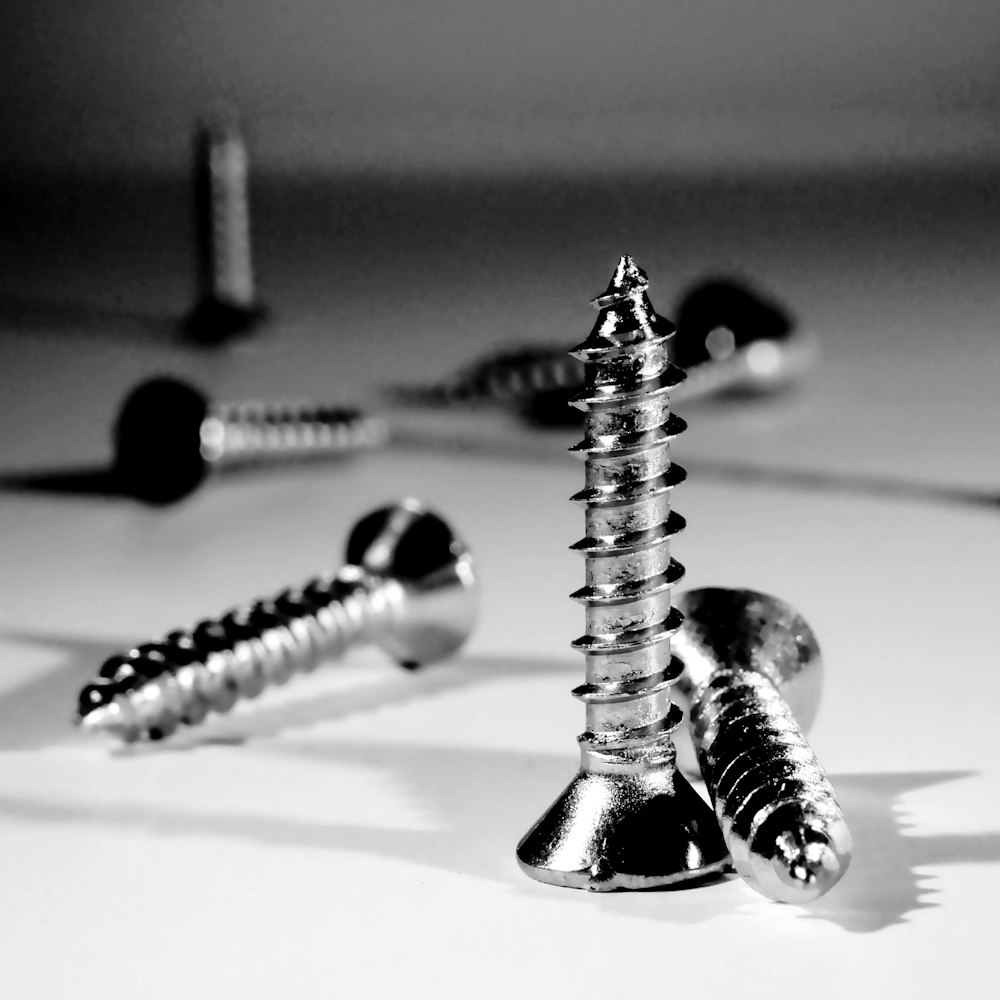
What we supply
- Hex washer head drilling screws
- With or without bonded EPDM washer, for roofing and cladding
- Pan, wafer and countersunk screws
- For panels, brackets, hinges and flush fixings
- Bi-metal stainless screws
- 304 or 316 body with a hardened carbon steel drill tip
- Self-tapping screws
- For pre-drilled holes, ISO 1481 and ISO 7049 type
- Drop-in anchors
- Flush and lipped, M6 to M20, with matching setting tools
- Threaded studs
- Rod for drop-in anchors, cut to length at our factory in Al-Jubail
Drill point number vs steel thickness
Pick the drill point from the total thickness of steel the screw must drill, counting every layer. The ranges below are typical published values; each maker’s own chart governs.
| Point | Typical screw sizes | Typical total steel thickness | Typical use |
|---|---|---|---|
| #1 | Small sizes only, from some makers | Very thin sheet; limit varies by maker | Ductwork and thin sheet. Not one of the SAE J78 point styles. |
| #2 | #6 to #10 (about ST3.5 to ST4.8) | About 0.035 to 0.110 in. (0.9 to 2.8 mm) | Light-gauge sheet, flashings, sheet to sheet stitching |
| #3 | #10, #12, 1/4 in. (ST4.8 to ST6.3) | About 0.110 to 0.220 in. (2.8 to 5.6 mm) | Cold-formed purlins, girts and steel framing |
| #4 | #12 and 1/4 in. | About 0.175 to 0.312 in. (4.4 to 7.9 mm), maker-dependent | Heavier cold-formed and light hot-rolled steel |
| #5 | #12 and 1/4 in. | About 0.250 to 0.500 in. (6.4 to 12.7 mm) | Hot-rolled sections and structural steel |
Typical values summarized from published maker selection guides; ranges differ between makers and with steel hardness. The unthreaded pilot section must be longer than the total steel thickness so drilling ends before the thread engages. Above about 12.7 mm, pre-drill and use a self-tapping screw or a bolt.
Drop-in anchor installation data, M6 to M20
Drop-in anchors are set in a hole of exact diameter and minimum depth. The table shows one maker’s published data for its anchor, as an example of what to ask for.
| Size | Drill diameter | Min. hole depth | Internal thread length | Max. install torque | Min. member thickness | Min. spacing / edge distance |
|---|---|---|---|---|---|---|
| M6 | 8 mm | 27 mm | 11 mm | 4.5 Nm | 80 mm | 200 / 150 mm |
| M8 | 10 mm | 32 mm | 14 mm | 11 Nm | 80 mm | 200 / 150 mm |
| M10 | 12 mm | 42 mm | 19 mm | 22 Nm | 80 mm | 200 / 150 mm |
| M12 | 15 mm | 52 mm | 25 mm | 38 Nm | 100 mm | 200 / 150 mm |
| M16 | 20 mm | 67 mm | 28 mm | 98 Nm | 130 mm | 260 / 195 mm |
| M20 | 25 mm | 82 mm | 38 mm | 130 Nm | 160 mm | 320 / 240 mm |
Example values from one manufacturer’s published data for its own anchor (anchor lengths 25 to 80 mm). Other makers use different lengths, depths and distances. Always install to the data sheet or approval report of the exact anchor supplied.
Saudi Arabia requirements for screws and drop-in anchors
On Saudi plant and infrastructure work, post-installed anchors usually need approval, and coastal corrosion drives the screw material. Check every point against your project specification.
| Requirement | What it means |
|---|---|
| Post-installed anchors on Saudi Aramco work | Based on an unofficial copy of SAES-Q-005 (28 September 2005), which may be superseded; confirm against the current revision in your project specification. That copy says post-installed anchor bolts are not used in new construction without prior written approval from Aramco’s civil engineering unit. |
| Design basis | The same copy requires approved post-installed bolts to be designed per ACI 318 Appendix D and in strict compliance with the maker’s recommendations. |
| Approval data | Use edge distance, spacing and load values from the ETA or ICC-ES report of the exact anchor, not from a generic table. |
| Coastal plants | Sites in Al Jubail, Ras Al Khair and Ras Tanura see chlorides, humidity and heat. Zinc-plated screws suit dry interiors only; outdoors use bi-metal stainless or a heavy multi-layer coating. |
| 410 stainless | Hardened 400 series stainless is prone to hydrogen-assisted stress corrosion cracking; 300 series bi-metal screws are preferred where corrosion is severe. |
| Heat and UV on roofs | Check that the EPDM washer rating covers roof surface temperatures; one maker rates its EPDM from -50 °C to +100 °C. |
| Import conformity | Imported fasteners move through SASO’s SABER platform, with a product certificate and a shipment certificate per consignment, according to HS code. |
Based on an unofficial copy of SAES-Q-005 (28 September 2005), which may be superseded; confirm against the current revision in your project specification. SABER requirements change; check the current rules for your HS code.
Where self-drilling screws and drop-in anchors are used
Screws fix sheet and light steel to steel; drop-ins hang services from concrete soffits.
Roofing and cladding
Hex washer head screws with bonded EPDM washers fix profiled sheet to purlins and girts.
Light steel framing
Wafer and pan head screws join studs, tracks and cold-formed sections.
HVAC and ductwork
Small #2 point screws fix duct seams, hangers and access panels.
Pipe and sprinkler hangers
Drop-in anchors with threaded rod carry pipe, sprinkler and duct supports from slabs.
Cable tray and strut
Drop-ins and rod suspend strut channel, cable tray and conduit runs.
Coastal and aluminum work
Bi-metal stainless screws fix aluminum and coated sheet in marine air.
Matched to your steel and concrete
We match point, length, washer and coating to the materials you are fixing, using the maker’s data.
- Point chosen by total steel thickness
- Bonded EPDM washers
- Bi-metal stainless for coastal sites
- Setting tools matched to anchor size
- Studs cut to length in Al-Jubail
Documents with the order
Paperwork comes from the manufacturer of each item and is passed to you with the delivery.
- Maker’s certificate of conformity
- Coating data from the maker
- ETA or ICC-ES report copy where one exists
- EN 10204 3.1 for threaded rod
- Third-party inspection on request
What is a self-drilling screw?
A self-drilling screw is a hardened tapping screw with a small twist-drill point on its tip. It drills its own hole, then forms or cuts a thread, then clamps the joint, all in one driving action.
The screw has four working parts. The head carries the drive and bearing surface. The thread forms the mating thread. Between the thread and the tip is an unthreaded pilot section. The tip carries the drill flutes.
The length of the flutes sets how much steel the point can drill. If the point is fully buried, chips pack the flutes and cutting stops. The point then overheats or snaps.
The pilot section matters as much as the point. One maker notes that threads advance up to ten times faster than a drill flute can remove metal. If the thread engages before the hole is finished, the screw jams or breaks.
Self-drilling vs self-tapping
A self-tapping screw forms its own thread but needs a pilot hole drilled first. A self-drilling screw makes that hole itself. Self-drilling screws are often called by one maker’s trade name; on an order, use the generic term and the standard.
Winged screws for wood to steel
Where timber over about 1/2 in. (12 mm) thick is fixed to steel, winged screws are used. The wings ream a clearance hole in the timber, then break off when they reach the steel.
Standards for self-drilling and self-tapping screws
Self-drilling screws are covered by ISO head standards, an ISO property standard, a legacy DIN standard and two US standards. Ask the supplier to state which one the screw meets.
The four ISO head standards cover thread sizes ST2.9 to ST6.3. They refer to ISO 10666 for the function of the drill point and to ISO 1478 for the tapping screw thread.
ISO 10666 sets the mechanical and functional properties. It checks surface hardness, the ability to drill the hole and form the thread, and torsional strength.
Which standard to name on an order
For metric roofing and cladding screws, name ISO 15480 (or DIN 7504 K) for hex washer heads. For US-style screws in steel framing, ASTM C1513 or SAE J78 is common.
SAE J78 has no point style 1. A #1 point is a maker’s own design, so ask for its drill range in writing.
| Standard | What it covers |
|---|---|
| ISO 15480 | Hexagon washer head drilling screws with tapping screw thread, ST2.9 to ST6.3 |
| ISO 15481 | Cross recessed pan head drilling screws with tapping screw thread |
| ISO 15482 | Cross recessed countersunk head drilling screws with tapping screw thread |
| ISO 15483 | Cross recessed raised countersunk head drilling screws with tapping screw thread |
| ISO 10666 | Mechanical and functional properties of drilling screws: hardness, drilling and thread forming, torsional strength |
| DIN 7504 | Former German standard in forms such as K (hex washer), N (pan), O (countersunk) and R (raised countersunk); replaced by the ISO 15480 series but still quoted |
| SAE J78 | Carbon steel self-drilling tapping screws for general use, point styles 2, 3, 4 and 5, with performance tests |
| ASTM C1513 | Steel self-drilling and self-piercing tapping screws for connecting cold-formed steel framing, including drill capacity tests |
| ISO 1481 and ISO 7049 | Slotted and cross recessed pan head self-tapping screws, ST2.2 to ST9.5 |
| ISO 2702 | Mechanical properties of heat-treated steel tapping screws, ST2.2 to ST9.5 |
Head types, drives and bonded washers
The head is chosen by what it must do: carry a sealing washer, sit low, or sit flush. The drive is chosen by the tool on site.
Hex washer heads are the standard for roofing and cladding. They drive with a nutsetter, give high torque and carry a bonded washer. A common hex size on #12 and ST5.5 screws is 8 mm (5/16 in.) across flats.
- Hex washer head (ISO 15480, DIN 7504 K): roofing, cladding and heavy steel; takes a bonded washer.
- Pan head (ISO 15481, DIN 7504 N): general sheet metal, brackets and enclosures.
- Wafer or pancake head: very low profile with a wide bearing face for steel studs and panels.
- Countersunk head (ISO 15482): flush fixing of hinges, plates and timber to steel.
- Raised countersunk head (ISO 15483): flush fixing with a neater domed finish.
- Truss or modified truss head: wide, low head for thin sheet and trim.
How bonded EPDM washers work
A bonded washer is a metal washer with an EPDM rubber face vulcanized to it. The metal may be galvanized steel, aluminum or A2 stainless. When the screw is driven, the EPDM compresses and seals around the shank and onto the sheet.
Washer outside diameters run from about 12 mm to 29 mm. Sizes of 16 mm and 19 mm are widely used on roofing screws. One maker rates its EPDM from -50 °C to +100 °C and describes it as UV resistant.
Getting the seal right
The washer seals only when the screw is driven square and to the right depth. One installer guide targets compression to about two-thirds of the washer’s original thickness.
Over-driving cracks or cups the rubber and can strip the thread. Under-driving leaves the rubber loose, so water passes. An angled screw leaves one side of the washer open. A depth-setting nosepiece on the screwdriver gives the same depth on every screw.
Materials and coatings for self-drilling screws
The screw must be much harder than the steel it drills. Makers state that the drilled steel should be at least 10 to 20 Rockwell points softer than the screw point.
Carbon steel screws are made from low-carbon steel such as AISI 1016 to 1024, then case hardened and tempered. Typical published values are a case hardness of HRC 52 to 58 and a core of about HRC 32 to 40. The hard case drills; the softer core resists snapping.
Zinc plating and phosphate
Plain electroplated zinc to ISO 4042 is thin and suits dry interiors only. One maker lists a trivalent chromium zinc layer of 8 to 14 µm. Phosphate finishes are for indoor use.
Multi-layer ceramic-type coatings
These systems stack a zinc layer, a chemical conversion layer and a baked ceramic top coat. Makers report salt spray tests, for example 1,000 hours to JIS Z 2371. Results vary by product, so ask for the maker’s test report rather than a generic claim.
Why 410 needs care
Type 410 can be hardened to drill steel, but it rusts more readily than 304. One maker warns that hardened 400 series screws are susceptible to hydrogen-assisted stress corrosion cracking. For severe exposure, 300 series bi-metal screws are preferred.
| Material | Drills steel? | Corrosion resistance | Typical use |
|---|---|---|---|
| Case-hardened carbon steel, zinc plated | Yes, #2 to #5 | Low; dry interiors | Indoor framing, ducts, enclosures |
| Carbon steel, multi-layer zinc and ceramic coating | Yes, #2 to #5 | Medium to high, by coating system | Roofing and cladding, sheltered outdoor steel |
| 410 martensitic stainless | Yes; case HRC 55 min typical | Better than plated steel, below 304 | Moderate outdoor exposure; avoid where HASCC is a concern |
| 304 (18-8) or 316 stainless, one-piece | No; hardened only by cold work | High | Aluminum, timber or pre-drilled holes |
| Bi-metal: 304 or 316 body, carbon steel tip | Yes, up to about 12 mm with #5 tip | High in the joint | Coastal roofing, aluminum and stainless sheet |
Hardness and capacity values are typical published maker values. Corrosion performance depends on the site and the coating system; makers do not usually warrant coating life.
Bi-metal stainless screws for coastal sites
A bi-metal screw has a 304 or 316 stainless body fused to a hardened carbon steel drill tip. The tip drills the steel; the stainless head, washer face and thread give the corrosion resistance.
Austenitic stainless steel cannot be through-hardened, so a one-piece 304 screw cannot drill structural steel. The bi-metal design solves this. One maker induction heat-treats only the point, so the stainless body does not become sensitized.
Bi-metal screws come with #2 or #3 tips for light-gauge steel and #4 or #5 tips for heavier steel up to about 12 mm. Heads include hex washer, wafer and countersunk.
Where they are worth the cost
Use bi-metal screws for roofing and cladding near the sea, as across Jubail Industrial City. They also suit aluminum and stainless sheet, and fixings in chemical fume zones.
They are also the usual answer for dissimilar metals. A plain carbon steel screw in aluminum sheet corrodes quickly once moisture is present.
Installing self-drilling screws
Good installation is mostly the right point, the right speed and the right depth. Most failures on site are misapplication, not bad screws.
Thread pitch and steel thickness
Coarse threads hold better in thin sheet. Fine threads suit thicker steel because they advance more slowly and engage more threads. Ask the maker which pitch is offered for each point.
Common mistakes
Most screw problems on site trace back to a few repeated errors.
- Using a #3 point in 6 mm steel: the point buries, overheats and snaps.
- Running the driver too fast: the cutting edges dull before the hole is through.
- Using an impact driver: shocks chip the hardened point and strip thin sheet.
- Over-driving sealing screws: crushed washers leak.
- Fixing aluminum with plain carbon steel screws: rapid galvanic corrosion.
- Add up the steel thickness of every layer the point must drill, and pick the point from the maker’s chart.
- Check the pilot section is longer than that total, so drilling finishes before the thread engages.
- Pick the length: material stack plus washer, plus enough thread to engage the base steel fully.
- Use a screwdriver, not an impact driver. One maker’s typical speeds are about 2,500 rpm for #8, 1,800 rpm for #12 and 1,200 rpm for 5/16 in.
- Hold the screw square to the surface and apply steady, moderate pressure. Too much force slows the tool and burns the point.
- Set the depth-setting nosepiece or clutch on a test screw, then check washer compression.
- For timber over about 12 mm thick on steel, use winged screws so the timber does not jack up the threads.
Drop-in anchors: how they work
A drop-in anchor is an internally threaded steel sleeve with a slotted lower end and a loose internal expansion plug. It is set in a drilled hole in concrete, then accepts a bolt or threaded rod.
To set it, a setting tool is struck with a hammer. The tool drives the plug down into the slotted end, which flares against the hole wall. The anchor is then ready for the bolt.
Because the anchor sits below the surface, it leaves a clean, flush slab. This makes drop-ins the usual choice for hanging pipe, duct, sprinkler and cable supports from concrete soffits.
Flush vs lipped drop-ins
A flush anchor sits at or just below the surface, so hole depth must be drilled accurately. A lipped anchor has a collar that rests on the surface, which fixes its position. Lipped types are also used in hollow-core slabs.
Sizes and materials
Common sizes are M6, M8, M10, M12, M16 and M20, needing drills of about 8 to 25 mm. Lengths for the same thread size vary between makers, so confirm the drill and depth for the anchor supplied.
Carbon steel anchors are usually zinc plated and suit dry interiors. Stainless anchors, for example in A4 (316 type), are used outdoors, in damp plant rooms and near the coast. A2 (304 type) may be offered where the project allows it; confirm the grade on the certificate.
Cracked and uncracked concrete
Concrete in tension zones, such as slab soffits under load, may crack. An anchor that holds in uncracked concrete can lose capacity when a crack runs through its hole.
Anchors for cracked concrete must be tested and assessed for it. One maker states that its drop-in holds a European Technical Assessment covering cracked and non-cracked concrete, for multi-point non-structural fixings.
Approvals: ETA and ICC-ES
In Europe, anchor performance is set out in a European Technical Assessment (ETA). In the US, ICC-ES evaluation reports for mechanical anchors are issued against AC193, Mechanical Anchors in Concrete Elements.
An approval belongs to one maker’s product, size and use. We supply anchors from established manufacturers; where an anchor holds an approval, we pass on the maker’s report. We do not claim approvals of our own.
How to install a drop-in anchor
Drop-in anchors are installed in five steps. The hole diameter, depth and cleanliness decide whether the anchor expands fully.
Choosing the bolt or rod
Use a bolt of the same metric thread and a matching property class and material. The bolt should engage the full internal thread length, typically 11 mm for M6 up to 38 mm for M20 in one maker’s range.
Too short a bolt leaves threads unengaged. Too long a bolt can bear on the plug and stop tightening. Our factory in Al-Jubail cuts threaded rod to the lengths your hangers need.
Inspection after setting
Check that every anchor was set with the correct tool and is flush or seated on its lip. Confirm the bolt engages fully and tightens without spinning. Where the project needs it, proof-load test a sample to the engineer’s procedure.
- Drill the exact diameter on the anchor’s data sheet with a carbide bit in hammer mode. One maker’s M8 needs 10 mm.
- Drill to at least the minimum hole depth. For a flush anchor, a depth stop on the drill keeps the top level with the surface.
- Clean the hole of dust with a blow pump and brush. Dust left in the hole stops the anchor seating and the plug travelling fully.
- Insert the anchor, slotted end first, and tap it flush. Use the setting tool sized for that anchor and strike until it is fully set as the maker describes.
- Fit the fixture, insert the bolt or rod, and tighten no higher than the maker’s maximum installation torque.
Edge distance and spacing basics
An anchor needs enough concrete around it to develop its load. Too close to an edge, the concrete splits or a cone breaks out. Too close to another anchor, the two breakout cones overlap and both lose capacity.
Each maker publishes minimum edge distance, minimum spacing and minimum member thickness for every size. These minimums often allow only reduced load; full capacity needs larger distances.
As an example, one maker’s M10 drop-in needs at least 200 mm spacing, 150 mm edge distance and an 80 mm thick member. Its M20 needs 320 mm, 240 mm and 160 mm. Other anchors differ.
Screws in sheet and light steel
Self-drilling screws also need edge distance in the sheet. One maker’s older data gave about 3/8 in. (10 mm) minimum edge distance and 11/16 to 3/4 in. (17 to 19 mm) spacing for #12 and 1/4 in. screws in steel. Use the current figures for the screw supplied and the sheet maker’s fixing pattern.
Practical rules
These checks avoid most layout problems on site.
- Take distances from the data sheet or approval report of the exact anchor supplied.
- Measure to the actual concrete edge, including openings, chamfers and cut slabs.
- Locate rebar before drilling; stop and re-drill if steel is hit, per the engineer’s rule.
- Fill abandoned holes as the project specification requires.
- Where loads are high or safety-critical, ask the engineer about wedge or chemical anchors instead.
RFQ checklist for screws and drop-in anchors
A complete enquiry lets us quote the right item the first time. Send the details below with quantities per line.
For self-drilling and self-tapping screws
- Standard or type, for example ISO 15480 or DIN 7504 K hex washer head
- Size and length, for example ST5.5 x 25 or 12-14 x 1 in.
- Drill point number, or the total steel thickness to be drilled
- Head and drive: hex washer, pan, wafer, countersunk; cross recess, square, six-lobe or hex
- Material: carbon steel, 410, or 304 or 316 bi-metal
- Coating: zinc plated, multi-layer coated, or color matched
- Washer: bonded EPDM, washer diameter and metal
- What is being fixed, and whether the site is coastal or chemical
For drop-in anchors
- Thread size and anchor length, for example M10 x 40
- Flush or lipped
- Material: zinc-plated carbon steel, or stainless grade
- Whether an ETA or ICC-ES report is required, and for cracked or uncracked concrete
- Setting tools and matching bolts or threaded rod lengths
- Concrete type and member thickness, if you want a selection check
Self-drilling screw and drop-in anchor questions
What is the difference between a self-drilling and a self-tapping screw?
A self-tapping screw forms its own thread but needs a pilot hole drilled first. A self-drilling screw has a drill point on its tip, so it drills the hole, forms the thread and fastens in one action. Self-drilling screws are faster in steel; self-tapping screws suit pre-drilled holes, plastics and steel too thick for a drill point.
What do the drill point numbers #1 to #5 mean?
The number indicates the length and capacity of the drill flute. Higher numbers drill thicker steel. Typical published ranges are about 0.9 to 2.8 mm for #2, 2.8 to 5.6 mm for #3, up to about 7.9 mm for #4 and 6.4 to 12.7 mm for #5. A #1 point is for very thin sheet. Always use the maker’s chart.
How do I choose the right drill point?
Add the thickness of every steel layer the screw must drill, then pick the point whose range covers that total. Check that the unthreaded pilot section is longer than the total, so drilling finishes before the thread engages. If the total is near the top of a range, move up one point number.
What is ISO 15480?
ISO 15480 is the international standard for hexagon washer head drilling screws with tapping screw thread, in sizes ST2.9 to ST6.3. It covers dimensions and refers to ISO 10666 for drilling performance and ISO 1478 for the thread. It is the usual metric standard for roofing and cladding screws, alongside the older DIN 7504 K.
Is DIN 7504 still valid?
DIN 7504 has been replaced by the ISO 15480 to 15483 series, but it is still widely quoted. Its form letters, such as K for hex washer head, N for pan head and O for countersunk, remain common in catalogs. Screws ordered to DIN 7504 or the matching ISO standard are broadly the same.
Can stainless steel self-drilling screws drill structural steel?
One-piece 304 or 316 screws cannot, because austenitic stainless steel hardens only by cold work. Type 410 can be hardened to drill steel but has lower corrosion resistance. For corrosion resistance and drilling ability together, use bi-metal screws: a 304 or 316 body with a hardened carbon steel tip.
Which screws should be used near the sea in the Eastern Province?
For exposed roofing and cladding on coastal sites, use bi-metal 304 or 316 screws, or carbon steel screws with a tested heavy multi-layer coating. Plain zinc-plated screws suit dry interiors only. Check the coating system against the sheet maker’s warranty conditions, which often name the fastener class.
How tight should a roofing screw with an EPDM washer be?
Tight enough to compress the EPDM evenly, not so tight that it splits or bulges out. One installer guide targets about two-thirds of the washer’s original thickness. Use a depth-setting nosepiece or clutch, drive square to the sheet, and check the first few screws by eye.
What is a drop-in anchor?
A drop-in anchor is an internally threaded steel sleeve set in a drilled concrete hole. A setting tool drives an internal plug into the slotted end, which expands against the hole. It then takes a bolt or threaded rod. Drop-ins are common for overhead pipe, duct, sprinkler and cable tray hangers.
What drill size does an M10 drop-in anchor need?
Most M10 drop-in anchors need a 12 mm drill, because the sleeve is larger than the M10 thread. One maker lists 8 mm for M6, 10 mm for M8, 12 mm for M10, 15 mm for M12, 20 mm for M16 and 25 mm for M20. Always confirm on the data sheet of the anchor supplied.
Can drop-in anchors be used in cracked concrete?
Only if the specific anchor has been tested and assessed for cracked concrete, and only for the use its approval covers. Some drop-ins carry a European Technical Assessment covering cracked concrete for multi-point non-structural fixings. For heavy or safety-critical loads, engineers usually specify wedge or chemical anchors.
Do your drop-in anchors have ETA or ICC-ES approval?
Approvals belong to individual manufacturers’ products, not to suppliers. We supply anchors from established manufacturers. If your specification calls for an ETA or ICC-ES report, tell us at enquiry stage. We will offer an anchor that holds one and pass on the maker’s report.
What edge distance does a drop-in anchor need?
It depends on the anchor, size and load. For example, one maker lists 150 mm minimum edge distance and 200 mm spacing for its M6 to M12 drop-ins. For M20 these rise to 240 mm and 320 mm. These are minimums; full load usually needs more. Use the data for the anchor supplied.
What should I send to get a quote?
For screws, send the standard or type, size and length, point number or steel thickness, head, material, coating, washer and quantity. For drop-ins, send thread size, length, flush or lipped, material, approval needs and quantity. Mention whether the site is coastal, and add setting tools and threaded rod if needed.
Updated
Related
Expansion and chemical anchors
Wedge, sleeve and chemical anchors for heavier loads.
Screws and rivets
Machine screws, wood screws and blind rivets.
Strut channel and fittings
Channel, brackets and rod hangers that drop-ins carry.
Send your screw and anchor list
Size, point or steel thickness, material and quantity are enough to start. We reply with a matched quote and data sheets.