
Wire rope slings, chain slings, polyester slings and chain blocks
Steel wire rope and wire rope slings, Grade 80 and Grade 100 chain slings, and polyester webbing and round slings. Also hand chain blocks and lever hoists, sourced from established lifting gear manufacturers and supplied from Al Jubail with WLL tags and test certificates.
Wire rope slings are lengths of steel wire rope with an eye at each end, rated with a working load limit (WLL) for each hitch. Each sling is proof tested and tagged before use. Most use 6×19 or 6×36 class rope with a steel core, built to EN 13414-1 or ASME B30.9 at 5:1. Chain slings and polyester slings do the same job where heat, edges or delicate surfaces call for them. JTE supplies certified slings, rope and hoists from established manufacturers; we do not make them.
- Steel wire rope
- 6×19 and 6×36 class, IWRC or fiber core, right regular lay, bright or galvanized; EN 12385-4 or API 9A
- Wire rope slings
- EN 13414-1, 8 to 60 mm; ferrule-secured or spliced eyes; 1, 2, 3 and 4 legs
- Chain slings
- Grade 80 to EN 818-4; Grade 100 to the maker’s rating; ASTM A906 for US-spec work
- Textile slings
- Polyester webbing and round slings to EN 1492-1 and EN 1492-2, color coded by WLL
- Hoists
- Hand chain blocks (ASME B30.16) and lever hoists (ASME B30.21)
- Design factor
- 5:1 wire rope slings; 7:1 polyester slings; chain slings about 4:1 on breaking force
- Documents
- Test certificate with sling ID, declaration of conformity, WLL tag on every sling
What we supply
- Steel wire rope
- Reels and cut lengths, bright or galvanized, with the maker’s certificate
- Wire rope slings
- Single and multi-leg, soft eye, thimble eye or with hooks and master links
- Chain slings
- Grade 80 and Grade 100, 1 to 4 legs, with shorteners if required
- Polyester slings
- Flat webbing and round slings, color coded by WLL
- Chain blocks and lever hoists
- Hand chain hoists and ratchet lever hoists with test certificates
Wire rope sling WLL by diameter and hitch
A sling’s WLL changes with the way it is rigged. The figures below are one maker’s ratings for 6x36WS IWRC rope, grade 1960, with ferrule-secured eyes at a 5:1 design factor. Ratings from other makers can be slightly lower, so the tag on the sling is the only figure to lift to.
| Rope diameter | Single leg, straight | Single leg, choke (x0.8) | Basket, legs parallel (x2) | 2-leg, 0 to 45° (x1.4) | 3 or 4-leg, 0 to 45° (x2.1) |
|---|---|---|---|---|---|
| 8 mm | 0.82 t | 0.66 t | 1.64 t | 1.15 t | 1.72 t |
| 10 mm | 1.28 t | 1.02 t | 2.56 t | 1.79 t | 2.69 t |
| 12 mm | 1.84 t | 1.47 t | 3.67 t | 2.57 t | 3.85 t |
| 14 mm | 2.51 t | 2.01 t | 5.03 t | 3.52 t | 5.28 t |
| 16 mm | 3.29 t | 2.63 t | 6.57 t | 4.60 t | 6.90 t |
| 20 mm | 5.12 t | 4.10 t | 10.24 t | 7.17 t | 10.75 t |
| 24 mm | 7.38 t | 5.90 t | 14.76 t | 10.33 t | 15.50 t |
| 28 mm | 10.04 t | 8.03 t | 20.08 t | 14.06 t | 21.08 t |
| 32 mm | 13.12 t | 10.50 t | 26.25 t | 18.37 t | 27.56 t |
Values from a European sling maker’s published table for zinc-coated 6x36WS IWRC 1960 slings (EN 13414-1, 5:1). Between 45° and 60° the 2-leg factor falls to 1.0 and the 3 or 4-leg factor to 1.5. Other makers publish rounded or lower figures for the same rope, for example 0.7 to 0.8 t at 8 mm. Always lift to the WLL on the tag and certificate.
Chain sling WLL: Grade 80 and Grade 100
Grade 100 chain carries about 25% more than Grade 80 of the same size. That lets a smaller, lighter chain do the same lift. The single-leg figures below are typical maker ratings; multi-leg ratings use the same mode factors as wire rope slings.
| Chain size | Grade 80, single leg | Grade 80, 2-leg 0 to 45° | Grade 80, 4-leg 0 to 45° | Grade 100, single leg | Grade 100, 4-leg 0 to 45° |
|---|---|---|---|---|---|
| 6 mm | 1.12 t | 1.60 t | 2.36 t | 1.4 t | 2.9 t |
| 7 mm | 1.50 t | 2.12 t | 3.15 t | – | – |
| 8 mm | 2.00 t | 2.80 t | 4.25 t | 2.5 t | 5.3 t |
| 10 mm | 3.15 t | 4.25 t | 6.70 t | 4.0 t | 8.4 t |
| 13 mm | 5.30 t | 7.50 t | 11.20 t | 6.7 t | 14 t |
| 16 mm | 8.00 t | 11.20 t | 17.00 t | 10 t | 21 t |
| 20 mm | 12.50 t | 17.00 t | 26.50 t | 16 t | 33.6 t |
| 22 mm | 15.00 t | 21.20 t | 31.50 t | 19 t | 40 t |
Grade 80 values from a UK maker’s EN 818-4 catalogue; Grade 100 values from a UK supplier’s published ratings. Grade 100 sizes and ratings vary by maker, and 7 mm is not offered by every Grade 100 range. Use a choke hitch at no more than 80% of the marked WLL.
Saudi Arabia requirements for slings and lifting gear
Lifting accessories sold in Saudi Arabia fall under SASO’s lifting equipment regulation, and Saudi Aramco sites add their own sling rules. The plant owner’s specification always decides; the points below show what to expect on an order.
| Requirement | What it means |
|---|---|
| SASO certificate of conformity | SASO’s Technical Regulation for Machinery Safety, Part 3: Lifting Equipment covers slings as lifting fittings. The supplier obtains a SASO certificate of conformity (ISO/IEC 17067 Type 1a). |
| SASO marking and language | Chains, ropes and belts show their safe working load. Product data is written in Arabic, and may also be in another language. |
| SASO listed standards | Annex 1 lists SASO GSO adoptions of EN 12385-4, EN 13414-1 and -2, EN 818-4, EN 1492-1 and -2, and ISO 4309. |
| SASO inspection | Lifting equipment is inspected after installation and examined periodically; the technical file carries a supplier declaration of conformity. |
| Saudi Aramco, eye type | Wire rope slings are Flemish eye with swaged sleeves. Fold-back eyes and aluminum ferrules are not allowed. |
| Saudi Aramco, tags and records | Each sling tag shows the maker, SWL and an ID number that links to its proof-load test certificate. |
| Saudi Aramco, use and inspection | No repaired slings, no shortening with knots or wire rope clips; pre-use checks by a certified rigger and a detailed inspection at least every 6 months. |
Based on an unofficial copy of Saudi Aramco GI 7.029, Rigging Hardware Requirements (issue dated 07/03/2011), which may be superseded; confirm against the current revision in your project specification. SASO points are from the Technical Regulation for Machinery Safety, Part 3: Lifting Equipment, published on saso.gov.sa. SABIC and Royal Commission sites set their own lifting rules; check your project specification.
Where slings and hoists are used
Every lift on a plant uses a sling or a hoist, often both.
Shutdowns and turnarounds
Pulling exchanger bundles, lifting valves, spools and pump casings.
Steel erection
Multi-leg chain and wire rope slings for beams, columns and pipe racks.
Piping and valves
Round slings on coated pipe and chain blocks for setting flanged spools.
Marine and jetties
Galvanized wire rope and slings on jetties, barges and offshore platforms.
Equipment lifting points
Slings with shackles on eye bolts and lifting lugs of skids and motors.
Rigging lofts
Restocking site stores with tagged slings, hoists and spare rope.
Match the sling to the lift
The sling, the hitch and the hardware must all carry the load.
- Rate by hitch and sling angle
- Keep angles within 60° of vertical
- Protect slings on sharp edges
- Shackle WLL at least the sling WLL
- No knots, clips or repairs
Documents with every sling
Each sling can be traced from its tag to its test certificate.
- Test certificate with ID number
- Declaration of conformity
- WLL tag on every sling
- Rope maker’s certificate
- Third-party inspection on request
Steel wire rope: classes, cores and lay
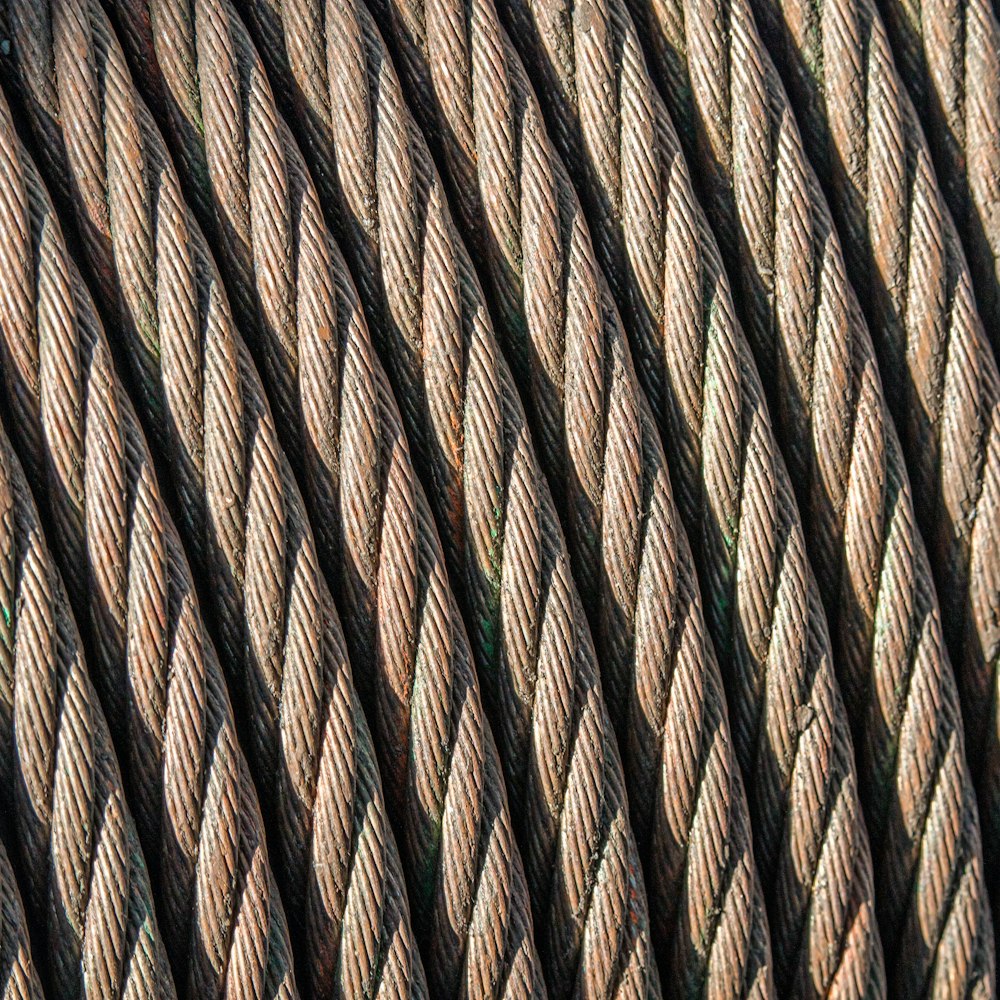
A steel wire rope is a set of strands laid around a core. Each strand is a set of wires. The class, core, lay and grade together decide strength, flexibility and wear life.
6×19 class rope has six strands of 15 to 26 wires. It resists abrasion well and is the stiffest common sling rope. 6×36 class rope has more, finer wires per strand, so it bends more easily around hooks and drums. US catalogs sell the same family as 6×37 class.
IWRC or fiber core
An independent wire rope core (IWRC) is a small wire rope at the center. It adds strength and resists crushing on drums and under tight bends. A fiber core (FC) adds flexibility but less support.
For the same 16 mm 6×36 rope, one maker rates an FC sling at 3.0 t and an IWRC sling at 3.3 t. Fiber core slings also have a lower temperature limit, so most plant slings use IWRC.
Right regular lay
In regular (ordinary) lay the wires twist the opposite way to the strands. Right hand means the strands are laid clockwise. Most general-purpose ropes are right regular lay, and it is the default for slings.
Lang’s lay twists wires and strands the same way. It is used where both rope ends are fixed against rotation, and is not preferred for slings.
Grade, bright or galvanized
Rope grade is the wire tensile strength. EN ropes are usually grade 1770 or 1960 N/mm². US grades IPS and EIPS are roughly equivalent to 1770 and 1960; EIPS is about 15% stronger than IPS.
Bright rope is uncoated and lubricated. Galvanized rope has zinc-coated wires and lasts longer near seawater and in humid coastal air. Both are available in grade 1960.
| Diameter | Min. breaking load | Single-leg sling WLL (ferrule eye, 5:1) |
|---|---|---|
| 8 mm | 44.7 kN | 0.82 t |
| 10 mm | 69.8 kN | 1.28 t |
| 12 mm | 100.5 kN | 1.84 t |
| 14 mm | 136.8 kN | 2.51 t |
| 16 mm | 178.6 kN | 3.29 t |
| 20 mm | 279.1 kN | 5.12 t |
| 24 mm | 401.9 kN | 7.38 t |
| 28 mm | 547.0 kN | 10.04 t |
| 32 mm | 714.5 kN | 13.12 t |
Breaking loads from a UK rope maker’s 6×36 IWRC 1960 list; sling WLL from a sling maker’s EN 13414-1 table. The WLL equals breaking load x 0.9 (ferrule efficiency) / 5 (design factor). Breaking load is never a working load.
EN 12385-4, API 9A and rotation-resistant rope
Two standards cover most rope bought for Saudi plants. EN 12385-4 sets materials, manufacturing and testing for stranded ropes for general lifting. Its tables give minimum breaking forces by class, size and grade.
API Spec 9A (27th edition, 2020) covers bright or drawn-galvanized wire rope for the petroleum and natural gas industries. It includes drilling lines, mooring lines and ropes for lifting slings and cranes. Rope to API 9A is usually sized in inches.
Rotation-resistant rope
Rotation-resistant rope lays its inner and outer strands in opposite directions, so the torques cancel. Typical constructions are 18×7, 19×7 and 35×7. It is mainly used as crane hoist rope, where a spinning load is dangerous.
It is not a sling rope. EN 13414-1 covers 6-strand and 8-strand ordinary lay ropes only. Follow the crane and rope maker’s instructions on handling and on swivels.
Ordering rope for cranes and winches
Crane and winch rope is specified by the equipment maker. Give the diameter, construction, core, lay direction, grade, finish and length on the reel, as the crane maker’s rope specification states.
| Diameter | EIPS | IPS |
|---|---|---|
| 1/4 in. | 6,800 lb | 5,880 lb |
| 3/8 in. | 15,100 lb | 13,120 lb |
| 1/2 in. | 26,600 lb | 23,000 lb |
| 5/8 in. | 41,200 lb | 35,400 lb |
| 3/4 in. | 58,800 lb | 51,200 lb |
| 7/8 in. | 79,600 lb | 69,200 lb |
| 1 in. | 103,400 lb | 89,800 lb |
Values from a US rope supplier’s 6×19 class IWRC listing (Federal Specification RR-W-410). The supplier notes that breaking strength is not a working load limit and that 5:1 is typical for general rigging.
Wire rope slings to EN 13414-1 and ASME B30.9
EN 13414-1 covers single, two, three and four-leg wire rope slings from 8 to 60 mm rope. Eyes may be ferrule-secured or spliced. ASME B30.9 covers slings of chain, wire rope, metal mesh, synthetic rope and webbing, and is the usual reference on US-spec projects.
Each leg of a multi-leg sling uses the same rope diameter and grade. Fittings at the lower end must be rated at least as high as the leg. The master link must be rated for the whole sling.
Eye terminations
A ferrule-secured eye folds the rope back and presses a ferrule over it. One maker’s WLL formula credits it with 90% of rope strength. A hand-spliced eye tucks the strands back into the rope and is credited with 80%.
A Flemish eye opens the rope into two parts, re-lays them into an eye and swages a steel sleeve over the ends. Saudi Aramco specifies Flemish eyes with swaged endings for wire rope slings. Based on an unofficial copy of Saudi Aramco GI 7.029 (07/03/2011), which may be superseded; confirm against the current revision in your project specification.
Soft eyes, thimbles and fittings
A soft eye is a plain loop for a hook or shackle. Where the eye carries a hook, ring or link, a thimble protects the rope. One maker’s standard soft eye is at least 15 rope diameters long.
- Plain rope between ferrules: at least 20 rope diameters
- Plain rope between splice tails: at least 15 rope diameters
- Length tolerance, ferrule-secured slings: plus or minus 2 rope diameters or 1%, whichever is greater
- Intermediate link on 3 and 4-leg slings: rated at least 1.6 times one leg
| Termination | How it is made | Notes |
|---|---|---|
| Ferrule-secured (turnback) eye | Rope folded back and pressed into a ferrule | Common in Europe to EN 13414-1. Not accepted on Saudi Aramco sites, which ban fold-back eyes and aluminum ferrules. |
| Flemish eye, swaged sleeve | Rope split, re-laid into an eye, steel sleeve swaged | The eye type Saudi Aramco specifies for wire rope slings. |
| Hand-spliced eye | Strands tucked back into the rope | Credited with 80% of rope strength in one maker’s formula, against 90% for a ferrule. |
| Wire rope clips | U-bolt clips over a turned-back rope | For guys and temporary rigging, about 80 to 90% efficiency. Saudi Aramco bans shortening slings with clips. |
Saudi Aramco points: Based on an unofficial copy of Saudi Aramco GI 7.029 (07/03/2011), which may be superseded; confirm against the current revision in your project specification.
Mode factors: how the hitch and angle change the WLL
A mode factor converts the single-leg WLL into the WLL for a hitch. A choke hitch bends the rope sharply at the choke point, so it is rated at 0.8. A basket with parallel legs shares the load between two parts, so it is rated at 2.
Angles are measured from the vertical. As the legs spread, each leg carries more tension for the same load. That is why the 2-leg factor drops from 1.4 to 1.0 when the angle goes past 45°.
- Multi-leg slings used in a choke hitch: reduce the WLL by 20%.
- Unequal leg lengths or an off-center load: assume fewer legs carry the load.
- EN ratings stop at 60° from vertical; do not rig the legs wider than that.
Worked example 1: two-leg lift
A 6 t pump skid is lifted with a 2-leg sling at about 50° from vertical. The 45 to 60° factor is 1.0, so each leg must have a single-leg WLL of at least 6 t.
From the table, 24 mm IWRC rope gives 7.38 t single leg. A 2-leg 24 mm sling is rated 7.38 t at 45 to 60°, which covers the lift.
Worked example 2: choke hitch
A 2 t bundle of pipe is choked with one sling. The choke factor is 0.8, so the sling needs a straight-pull WLL of 2 / 0.8 = 2.5 t.
14 mm rope gives 2.51 t straight and 2.01 t choked, so it just works. Rounding up to 16 mm leaves a margin for an uneven center of gravity.
Bending over small diameters
A wire rope loses strength when bent around a small diameter. Bent around a pin of its own diameter, a rope keeps only about half its capacity.
Saudi Aramco reduces the rated load when the D/d ratio is below 25. Based on an unofficial copy of Saudi Aramco GI 7.029 (07/03/2011), which may be superseded; confirm against the current revision in your project specification. Use a shackle or pin large enough for the sling eye.
| Configuration | Mode factor | Example: 3.29 t single-leg sling |
|---|---|---|
| Single leg, straight pull | 1.0 | 3.29 t |
| Single leg, choke hitch | 0.8 | 2.63 t |
| Basket, legs parallel | 2.0 | 6.57 t |
| 2-leg, 0 to 45° from vertical | 1.4 | 4.60 t |
| 2-leg, 45 to 60° from vertical | 1.0 | 3.29 t |
| 3 or 4-leg, 0 to 45° | 2.1 | 6.90 t |
| 3 or 4-leg, 45 to 60° | 1.5 | 4.93 t |
Factors as published by EN 13414-1 sling makers. Chain slings to EN 818-4 use the same 1.4, 1.0, 2.1 and 1.5 factors. Textile sling tables to EN 1492 publish the 0 to 45° factors. ASME B30.9 uses rated load tables by hitch and angle, so check the US tag rather than applying EN factors.
Chain slings: Grade 80 and Grade 100
Chain slings are made from short-link alloy steel chain joined to master links, hooks and connecting links. They resist heat, cuts and abrasion better than wire rope or polyester. They are a common choice for steel erection and rough loads.
In Europe, Grade 8 chain slings are built to EN 818-4, using chain to EN 818-2 and components to EN 1677. In the US, ASTM A906 covers Grade 80 and Grade 100 chain slings. It uses chain to ASTM A391 (Grade 80) or A973 (Grade 100) and components to A952.
Ratings and testing
Grade 80 chain has a breaking force about four times its WLL; 8 mm chain breaks at about 80 kN for a 2 t WLL. One maker proof tests to 2.5 times WLL and fatigue tests to 20,000 cycles at 1.5 times WLL.
Grade 100 uses a stronger steel. Ratings and temperature limits are set by each maker, so do not mix Grade 80 and Grade 100 components in one sling.
Temperature
One Grade 80 maker allows full WLL from -40 to 200 °C, 90% to 300 °C and 75% to 380 °C. One Grade 100 range is rated only from -40 to 200 °C. ASTM A906 does not cover slings above 200 °C (400 °F).
Saudi Aramco limits alloy chain slings to the range -40 °C to 316 °C (600 °F). Based on an unofficial copy of Saudi Aramco GI 7.029 (07/03/2011), which may be superseded; confirm against the current revision in your project specification. Chain exposed to heat beyond the maker’s limit is taken out of service.
Edges and shock
One maker cuts the WLL to 70% over an edge with a radius between one and two chain diameters. Sharper edges take it to 50%. Medium shock loads also take 30% off the WLL, and strong shock is not allowed.
| Check | Discard when |
|---|---|
| Chain link stretch | Pitch has grown 5% over nominal |
| Chain link wear | Mean link diameter has worn below 90% of nominal |
| Master and joining links | Elongated 10% or worn 15% |
| Hooks | Throat opening enlarged more than 10%, latch missing or not working |
| Any part | Cracks, nicks, bent or twisted links, heat discoloration, missing tag |
From a UK Grade 80 maker’s user instructions. Saudi Aramco also requires the user to measure chain sling links before use (GI 7.029). Based on an unofficial copy of Saudi Aramco GI 7.029 (07/03/2011), which may be superseded; confirm against the current revision in your project specification. Follow the limits in the instructions supplied with your sling.
Polyester webbing and round slings (EN 1492-1 and EN 1492-2)
Flat webbing slings (EN 1492-1) and round slings (EN 1492-2) are light and soft. They protect painted, coated and machined surfaces. Polyester slings are rated at a 7:1 safety factor and carry a blue label.
Both standards color code the sling by its single-leg WLL, so a rigger can read the capacity at a glance. The color only shows the WLL of one sling, not of a multi-leg assembly.
Temperature and chemicals
Polyester and polyamide slings are typically rated from -40 °C to +100 °C, and polypropylene to +80 °C. ASME B30.9 sets a lower ceiling of 194 °F (90 °C) for synthetic webbing and round slings.
Polyester resists moderate acids but is damaged by alkalis. Polyamide resists alkalis but is attacked by acids, and loses about 10% strength when wet. Ask the maker before using any textile sling near chemicals.
Edges and UV
A textile sling can be cut on an unprotected steel edge at well below its WLL. ASME B30.9 calls for load-rated cut protection where a synthetic sling bears on edges or corners.
Sunlight degrades synthetic yarns over time. Store textile slings indoors, dry and away from heat, and discard any sling with cuts, burns, heavy abrasion or a missing label.
| Color | WLL, straight lift |
|---|---|
| Violet | 1 t |
| Green | 2 t |
| Yellow | 3 t |
| Grey | 4 t |
| Red | 5 t |
| Brown | 6 t |
| Blue | 8 t |
| Orange | 10 t and above |
Color code per EN 1492-1 and EN 1492-2 as published by European sling makers. Above 10 t the sling is orange and the WLL is read from the label.
Chain blocks and lever hoists
A chain block (hand chain hoist) lifts a load by pulling a hand chain loop that drives the load chain through gearing. It hangs from a beam clamp, trolley or lifting point and lifts freely suspended loads vertically.
A lever hoist, also called a ratchet hoist or come-along, is worked by a ratchet lever. It is used for lifting, pulling and tensioning, so it suits pipe alignment, pulling and short lifts in tight spaces.
Standards
ASME B30.16 (2022 edition) covers overhead, underhung and stationary hoists, including hand chain-operated chain hoists. ASME B30.21 (2025 edition) covers lever hoists with chain, rope or web strap, for lifting, pulling and tensioning. In Europe, EN 13157:2004+A1:2009 (Cranes, Safety, Hand powered cranes) covers hand chain blocks and lever hoists.
Safe use
Never use a hoist to lift people. Do not extend the lever with a pipe; if the hoist will not operate with normal hand effort, the load is too heavy or the hoist is faulty.
Keep the load chain straight and untwisted, and never wrap it around the load. Check that the hook latch closes and the brake holds before every lift.
| Point | Chain block | Lever hoist |
|---|---|---|
| Operation | Hand chain loop from below | Ratchet lever at the hoist |
| Direction | Vertical lifting | Lifting, pulling and tensioning |
| Lift height | Any height; specify the lift and hand chain drop | Short lifts and pulls, limited by chain length |
| Typical use | Maintenance lifts under beams and in plant rooms | Pipe alignment, pulling equipment, tensioning |
| US standard | ASME B30.16 | ASME B30.21 |
Inspection and discard criteria
Slings are inspected before each use and in a recorded periodic inspection by a competent person. Any sling with a missing or illegible tag is taken out of service, whatever its condition.
For crane and hoist ropes, ISO 4309:2017 gives the care, inspection and discard rules, including diameter reduction and corrosion. For slings, the maker’s instructions, EN 13414-2 and ASME B30.9 apply.
Wire rope slings: remove from service when
- 10 randomly distributed broken wires in one rope lay, or 5 broken wires in one strand in one rope lay
- Outside wires worn by one third of their original diameter
- Kinking, crushing, birdcaging or any other distortion of the rope
- Heat damage, including metallic discoloration, or fiber core slings exposed above 180 °F (82 °C)
- Severe corrosion with pitting, or wires binding
- Cracked, bent or worn ferrules, sleeves and end fittings; slipped splices
- Lay length increased, which shows the sling has rotated under load
Polyester slings: remove from service when
- Cuts, tears or severed outer yarns
- Burns, melting, glazing or weld spatter
- Chemical damage or heavy soiling that cleaning cannot remove
- Damaged stitching, eyes or end fittings
- Missing or illegible label
| Sling type | Temperature range |
|---|---|
| Wire rope, fiber core | -40 to 180 °F (-40 to 82 °C) |
| Wire rope, IWRC | -40 to 400 °F (-40 to 204 °C) |
| Alloy steel chain | -40 to 400 °F (-40 to 204 °C), or the maker’s derated range |
| Synthetic webbing and round slings | -40 to 194 °F (-40 to 90 °C) |
As tabulated from ASME B30.9 in a US national laboratory’s rigging manual. These limits are not exceeded without the maker’s written approval. EN-rated textile slings are typically marked -40 to +100 °C.
Wire rope, chain or polyester: which sling to use
Choose the sling by the load surface, the temperature and the edges, then by weight and cost. Wire rope slings are the general workhorse. Chain suits heat and rough loads, and polyester protects finished surfaces.
In Jubail Industrial City, Ras Al Khair and Ras Tanura, sand, salt air and summer heat shorten sling life. Galvanized rope, covered storage and short inspection intervals pay for themselves.
| Point | Wire rope sling | Chain sling | Polyester sling |
|---|---|---|---|
| Design factor | 5:1 | About 4:1 (Grade 80) | 7:1 |
| Heat | IWRC to 204 °C under B30.9 | Up to 200 °C at full WLL; higher with derating | To about 90 to 100 °C |
| Edges | Needs packing on sharp edges | Best, but still derated on sharp edges | Needs load-rated edge protection |
| Load surface | Can mark painted or coated items | Can damage finished surfaces | Gentle on coated pipe and machined parts |
| Weight | Medium | Heaviest | Lightest |
| Adjustable length | No | Yes, with shortening hooks | No |
| Main failure signs | Broken wires, kinks, birdcaging | Stretch, wear, cracks | Cuts, burns, missing label |
Certificates, tags and how to order
Every sling is identified by its tag and backed by a test certificate with the same ID number. Under ASME B30.9 practice, a wire rope sling tag shows the maker and rope size. It also shows rated loads by hitch and angle, and the number of legs.
Saudi Aramco chain sling tags also show the steel grade, reach, number of legs, the SWL with its angle, and the ID number. Based on an unofficial copy of Saudi Aramco GI 7.029 (07/03/2011), which may be superseded; confirm against the current revision in your project specification. SASO requires a supplier declaration of conformity in the technical file. Rope on reels comes with the maker’s certificate of diameter, construction, grade and breaking force.
Common mistakes
- Ordering by rope diameter alone, without the hitch, angle and number of legs.
- Adding the WLL of each leg of a multi-leg sling instead of using the mode factor.
- Shortening a sling with knots or wire rope clips.
- Using a shackle or hook rated below the sling.
- Using a polyester sling on a sharp steel edge without rated protection.
- Keeping slings with missing tags in service.
- Type: wire rope sling, chain sling, polyester webbing or round sling, chain block or lever hoist.
- Capacity: WLL per leg or total WLL with the sling angle, or hoist capacity in tonnes.
- Wire rope: diameter, class (6×19 or 6×36), core, grade, bright or galvanized, rope standard.
- Construction: number of legs, effective length (bearing to bearing), eye type, thimbles.
- Fittings: master link, hooks with safety latches, shorteners, shackles.
- Hoists: lift height, hand chain drop, headroom and suspension (hook, beam clamp or trolley).
- Documents: test certificate, declaration of conformity, SASO conformity, third-party inspection if required.
Wire rope sling and chain block questions
What is the safety factor of a wire rope sling?
Wire rope slings are rated at a 5:1 design factor under EN 13414-1 and ASME B30.9. The rope’s minimum breaking load, reduced for the termination efficiency, is divided by five to give the single-leg WLL. Saudi Aramco also requires a minimum 5:1 design factor, based on an unofficial copy of GI 7.029 (07/03/2011), which may be superseded; confirm against the current revision in your project specification. Polyester slings use 7:1, and Grade 80 chain slings break at about four times their WLL.
What is the difference between 6×19 and 6×36 wire rope?
Both have six strands. 6×19 class strands have 15 to 26 wires, so the wires are thicker and resist abrasion better, but the rope is stiffer. 6×36 class strands have more, finer wires, so the rope bends more easily and suits slings that wrap around loads and hooks. US catalogs call the 6×36 family 6×37 class.
Should I choose IWRC or fiber core rope for slings?
Choose IWRC for most plant slings. The steel core adds strength and crush resistance. ASME B30.9 allows IWRC slings up to 400 °F (204 °C), against 180 °F (82 °C) for fiber core. For a 16 mm 6×36 sling, one maker rates IWRC at 3.3 t and fiber core at 3.0 t. Fiber core is lighter and more flexible.
What does right regular lay mean?
Regular, or ordinary, lay means the wires in each strand twist the opposite way to the strands in the rope. Right hand means the strands are laid clockwise. Right regular lay is the standard lay for most general-purpose rope and for slings. Lang’s lay twists wires and strands the same way and is not preferred for slings.
How does a choke hitch change the WLL?
A choke hitch bends the rope sharply where the eye grips the body. EN tables rate a single choked sling at 0.8 times its straight-pull WLL. A multi-leg sling used in choke is also reduced by 20%. A 16 mm IWRC sling rated 3.29 t straight is about 2.63 t choked. Always read the rating from the tag.
Why is a ferrule-secured eye not accepted on Saudi Aramco sites?
Saudi Aramco requires wire rope slings with Flemish eyes and swaged endings, based on an unofficial copy of GI 7.029 (07/03/2011), which may be superseded. Fold-back eyes and aluminum ferrules are prohibited. European ferrule-secured slings to EN 13414-1 are therefore not ordered for those sites. Confirm against the current revision in your project specification.
What are the discard criteria for a wire rope sling?
Remove a wire rope sling when it has 10 random broken wires in one rope lay, or 5 in one strand of one lay. Also remove it for kinks, crushing, birdcaging, heat damage, severe corrosion, cracked fittings, slipped splices or a missing tag. Worn outside wires and an increased lay length are further reasons to discard it.
What is the difference between Grade 80 and Grade 100 chain slings?
Grade 100 chain is made from a stronger alloy steel and carries about 25% more than Grade 80 of the same size. An 8 mm single leg is typically 2.0 t in Grade 80 and 2.5 t in Grade 100. Grade 100 is lighter for the same lift but often limited to 200 °C. Never mix components of different grades.
What do the colors of polyester slings mean?
Under EN 1492-1 and EN 1492-2 the body color shows the single-leg WLL. Violet is 1 t, green 2 t, yellow 3 t and grey 4 t. Red is 5 t, brown 6 t, blue 8 t and orange 10 t and above. The blue label shows the sling is polyester. Always confirm the WLL on the label before lifting.
Can I use a polyester round sling at high temperature?
Only within its rating. EN-rated polyester slings are typically marked -40 °C to +100 °C. ASME B30.9 limits synthetic webbing and round slings to 194 °F (90 °C). In Saudi summers, steel surfaces in the sun can get hot, so check the load temperature. Use chain or IWRC wire rope for hot loads.
What standards cover chain blocks and lever hoists?
ASME B30.16 covers overhead, underhung and stationary hoists, including hand chain-operated chain blocks. ASME B30.21 covers lever hoists with chain, rope or web strap, used for lifting, pulling and tensioning. In Europe, EN 13157 covers hand-powered lifting equipment, including hand chain blocks and lever hoists. Your site rules set the inspection interval and the certificate format.
Is ISO 4309 used for wire rope slings?
ISO 4309:2017 sets the care, inspection and discard rules for wire ropes on cranes and hoists. It is used for crane hoist and boom ropes, not slings. Sling inspection follows the maker’s instructions, EN 13414-2 and ASME B30.9. SASO lists ISO 4309 among the standards for lifting equipment in Saudi Arabia.
Do slings sold in Saudi Arabia need SASO certification?
Yes. SASO’s Technical Regulation for Machinery Safety, Part 3: Lifting Equipment counts slings as lifting fittings. The supplier must obtain a SASO certificate of conformity, mark the safe working load and provide data in Arabic. The technical file includes a supplier declaration of conformity. Lifting equipment is also inspected after installation and periodically.
What certificates come with a sling from JTE?
Each sling comes with the maker’s test certificate showing its ID number, WLL and proof-load test, matching the tag. A declaration of conformity and SASO conformity documents are supplied as required. Wire rope comes with the maker’s certificate of construction and breaking force. Third-party inspection can be arranged on request.
Updated
Related
Lifting and rigging hardware
Shackles, turnbuckles, wire rope clips and hoist rings.
Eye bolts and eye nuts
DIN 580 eye bolts and DIN 582 eye nuts for lifting points.
Shutdown bolting kits
Bolting and hardware packed for turnarounds.
Send your sling and hoist list
Give the type, WLL, legs, length and fittings: we quote certified slings, wire rope and hoists with test certificates from Al Jubail.